Monday, 14 December 2015

Drawing in response to research

Although I found this exercise fairly useful, I don't really like the outcomes, and I think it is too early on in the project to begin working visually alongside the theory work.

What do I like?
- Choice of colour
- Fairly anonymous shapes of bodies
- Use of silhouettes- it could be anyone

What don't I like?
- Line, think it is to harsh
- Not enough detail
- Too cliched for some of them (e.g. replacing heads)

What will I do next?
- Explore different media
- Investigate new ideas and themes
- Research more around my topic
Thinking about the connotations of some designer products
Part 1
Part 2- showing the impact and sadness of consumerism
Part 1
Part 2- looking at what all these brands are doing to people
and how they personify themselves

Saturday, 12 December 2015

Study task 4 triangulation and Harvard referencing

Throughout First Things First 2000, Adbusters (2000) claims that the skills of graphic designers are going to waste, and that they are all actually helping to ‘draft a reductive and immeasurably harmful code of public discourse’ within this consumer based world. This is something which Kalman (1998) expands on in Fuck Committees where he exposes how these big corporations are taking over the artistic license of graphic design through making false claims ‘to understand the needs of the mass audience’, whilst they actually are just pushing their own ideologies onto the public through clever design and advertising. Garland would take and even more bleak look on the matter, as he states in First Things First (1964) that the impact of advertising and consumerism on graphic designers has ensured the profession is far from its original intent, and now, sometimes even contributes ‘little or nothing to out national prosperity’. Garland then goes on to propose a ‘reversal of priorities’ which would help to develop ‘more lasting forms of communication’ between designers and their audiences, made possible only by the eventual tiring of society to ‘gimmick merchants’. Kalman, however, would argue that a solution is much more achievable through hard work, as if the wealthiest in the country were to realise that design was about more than just ‘fatter wallets, but about creating a future’ then a new era would arise. He goes on to state that to make this happen, ordinary individuals must work hard to make it so, and that a change in society is just around the corner if only people would strive after it (1998). The final argument, from Adbusters, takes a middle groud to the previous texts as they state that if a competition to consumerism is brought in, one which evokes a ‘new kind of meaning’ to design, then the public would easily decide it to be the better alternative, and that the only course of action to be made is to offer a gentler, more preferable alternative to the public, in the faith that they will choose it (2000).


The above image has strong connotations about the impact of consumerism, which hold strong links to Kalman’s text Fuck Committees (1998) where he discusses how the beauty of design has been completely overtaken by the ideologies of rich, powerful corporations who are seeking solely profit. This image of the Coca Cola advert shows just the kind of thoughts that Kalman is talking about, as the re-appropriation of the basic but instantly recognisable design shows a struggle for the truth to be ousted, and for the connotations of huge corporations to be revealed, as it is not often huge, multi million pound companies are associated with the word ‘love’. When Kalman urges the reader to ‘look for the cracks in the wall’ it seems clear he is talking about actions similar to what is contained in this image, as this advert has now become as symbolic for consumerism as it is for Coca Cola. This is a slight push at revealing the real creator of the advert, not an artistic ‘love fuelled’ act, but a well considered, consumer driven ideology which strives to hook in more consumers, more money and ultimately, more profit.

The message of Garland’s First Things First (1964) Is extremely clear, as the statements of who ‘the undersigned’ are, and the wasted ‘efforts of those working in the advertising industry’ show immediately which ‘side’ he is on. However, after ridiculing the advertising industry and saying how much of a waste it is, he then goes on to say they ‘do not advocate the abolition of high pressure consumer advertising’, which contrasts strongly with his message throughout the text, as he tries to urge people to step away from the consumer lifestyle, whilst still saying its collapse ‘is not feasible’. This strange juxtaposition somehow weakens his argument, as the optimism for success is dampened somewhat by the point blank refusal to suggest that a life without consumer driven adverts is possible. However, he does finish in a very polite manner, which suggests the manifesto is more a mere suggestion, proposed to allow the reader to make up their own mind on the matter, which is the exact opposite of what he says the big corporations are doing.

The text by Adbusters (2000), First Things First 2000 discusses how the evolving of design has meant that the meaning of Graphic Design has changed to broadly mean designing advertising, as this is ‘the most lucrative, effective and desirable’ use of their talents. They go on to state how this reliance on the money and recognition from this kind of work has changed ‘how the world perceives design’, and in fact how the world perceives itself to some extent. Adbusters then go on to offer alternative uses of their skills, through a ‘reversal of priorities’. The solution they propose is to offer up a contender to consumeristic design, where designers would join them in their manifesto to help change the way the world sees design.

Sources:

Adbusters (2000) First Things First 2000, [internet] Available <http://www.manifestoproject.it/adbusters/>. [12/12/15]

Garland, K. (1964) First Things First [internet] Available <http://www.manifestoproject.it/ken-garland/>. [12/12/15]

Kalman, T. (1998)  Fuck Committees, [internet] Available <http://www.manifestoproject.it/fuck-committees/>. [12/12/15]

Sunday, 6 December 2015

Plan feedback

After Context of Practise group tutorials, I now have a lot clearer of an idea about what approach to take in regards to my question.

Some of the aspects we looked at in my essay plan were:

Is this realistic for a 3000 word essay?
-Too many concepts trying to be put in, narrow it down
-Is the sustainability section needed?

Is it focussed or very general?
- Should be narrowed down to a particular type of packaging, e.g. foods
- Could look at the differences in prices of packaging, value vs top of the range, and the reasons behind this

Do the quotes/sources match well?
-Broad research with many sources
-Sustainability sources not really necessary

Any suggestions? Sources to look at etc.
-Look at top of the range packaging and why these choices have been made e.g. iPhone boxes
-Compare high end and 'no frills' products, do the supermarkets actually want you to buy the cheaper, plainer products? Or is it to make you want the more expensive one?
-Look at colour theory, Heinz green ketchup, difference between red and white wine and how packaging uses colour theory.


The next thing I will do is create a clearer and more direct essay plan which includes succinct overviews of content and sources, as well as investigate and research colour theory and packaging techniques further.

Friday, 27 November 2015

Potential images

Thinking about how I want to structure my essay, I started to realise my initial chosen images were not totally appropriate to the content, as I want to look more at the effects of packaging on the consumer, and I felt the images I had chosen were focused more on just consumerism in general. However in order to look at the relationship between packaging and product I need to focus more on the actual product itself, and a good way to go about this would be to compare several different packaging techniques of the same type of product, and how this impacts upon the decision to buy that thing. 
I chose these images because I thought they were all very pleasing and 'nice' examples of tea packaging, yet they were actually quite impractical, and potentially wasteful, so I thought this would be an interesting starting point from which to look at how consumers respond to packaging.


Essay quotes

Through preliminary research I have selected some quotes which I feel will allow me to build a strong foundation for my essay question, as they show different viewpoints and arguments whilst still maintaining credible and interesting content.


'the package is an extremely important substitute for the personal relationship that people desire'- Humphery p.65

'now the package must do its own selling job, and for that reason a great deal more interest must be taken in the proper packaging of merchandise... the package must 'get attention, arouse interest, create desire, get action'' - Humphery p.87

'modern exchange is not materialistic. It is objects that people really desire, but their lush coating of images and dreams that mesh with a wider promotional culture fuelled by advertising and the broadcast media' - Cummings and Lewandowska p.76

'In one, s/he has no choice:the choice is imposed, even if it feels like spontaneous desire... (the other) is restricted only by a lack of information... these two versions rotate around the same two poles... full information or utter impressionability' - Bowlby p.3

'for the retailer, self-service meant that Mrs Consumer became someone to know but not to meet; to sell to but not to see' - Humphery p.93

'signing the... petition changed the view these people had of themselves... later... they complied in order to be consistent with their newly formed self-image' - Cialdini p.73

''much-loved' brands... instil in us all a 'product loyalty'... (however) brand names are rarely used used to remember shopping past. It was not brands that people recalled but specific food products' - Humphery p.126

'product displays translate into changing 'exhibitions' as everything is cloaked in a subtle nostalgia, repositioning the store as a tourist destination akin to other cultural sites' - Cummings and Lewandowska p.22

'we are now encouraged to use every object or image to imaginatively extend ourselves;... in a sense, a purchase now 'makes' us' - Cummings and Lewendowska p.131

'buying as fulfilment... replaces other forms of leisure' - Humphery p.193

'The price which a person pays for a thing can never exceed, and seldom comes up to that which he would be willing to pay rather than go without it: so that the pleasure which he gives up in paying away its price; and he thus derives from the purchase a surplus of please. The excess of the price which he would be willing to pay rather than go without the thing over that which he actually does pay, is the economic measure of this surplus pleasure, and may be called Consumers' Rent' - Bowlby p.14

'the figure of the girl herself, who 'feeds on' or consumes the beautiful things caricatured as obvious indicators of the consciously aesthetic consumer lifestyle' - Bowlby p.15

'whether people like or dislike the supermarket, demarcate between necessity and leisure shopping, or seek a sense of pleasure through the shop, the very same people often express a quite detailed critique of 'consumer society'' - Humphery p.196

'around a quarter of the British public (26 per cent) report that they have advised someone against using a company because it had not acted responsibly, and a similar proportion (24 per cent) has positively advised some one to use a company because of its responsible actions' - Harrison, Newholm and Shaw p.202

'all the world's a showroom, every man or woman is an advertisement for himself or herself' - Bowlby p.95

'it could be that ethical credentials are seen as a fundamental part of doing business, or simply an 'added extra' or even a passing fad, but either way these firms will not principally position their products on this basis' - Harrison, Newholm and Shaw p.223

'the most risible attempts at corporate 'greenwash' are probably behind us now... Corporations now seem to be even more reserved and cautious about about the types and claims that they make... whereby specific 'ethical' claims are regulated behind other brand attributes' - Harrison, Newholm and Shaw p.228

Wednesday, 25 November 2015

Coby Persin- Money Suit Experimentation

After seeing this video I was instantly touched by the sentiment of this, and I think it really shows the actual value of money in this consumerist driven world. I feel that this is an extremely important example of just how much of an effect advertising has on the individual, as the more product driven people took more money from Persin, even though they admitted they didn't need it, but simply justified it by fuelling their superficial 'needs'. The only person featured who didn't take a lot of cash was the only one who actually needed it to aid his survival. I think this video really shows the real way in which money and the race to have the best in life can really have a detrimental effect on individuals. 

Overall I feel this video is summed up by its end text:
'you have succeeded in life when all you really want is only what you really need'.


Lecture- Consumerism: Persuasion, society, brand and culture

I found this lecture, focused on the rise of US consumerism from the early 20th century, extremely interesting, as it related directly to my chosen essay question.

One theory is that consumerism was created to keep people happy, docile and ultimately controlled, in the US after WW1.

Freud: 
-Civilisation is not necessarily about improvement or development, and if it is, it comes at the price of happiness, as it oppresses our natural urges

-Fundamental tension between civilisation and the individual

-When war broke out he took this as validation of his theory, that violence is simply the release of human urges which are repressed due to society norms

Edward Bernays:
-Freud's nephew

-Bernays created propaganda during WW1 in the US, which would now be regarded as public relations, therefore he is seen as the founder of modern day PR. In essence PR, marketing and propaganda are the same thing

-He believed that if people feel like their desires are being met it is easy to manipulate them

-One of his most famous acts was in 1929 when he hired actresses to take part in the Easter Day parade as 'debutants' but halfway through lit a cigarette, which was out of social comfort zones for young women during that time. This ended up escalating into a political and social statement, as it was linked to suffragettes. Around this time Bernays began to realise that if products are linked to desire and elegance, people are so desperate to satiate their oppressed urges that they unconsciously behave irrationally, often against their own good nature.

-Throughout his career, Bernays introduced, among other things, product placement, celebrity endorsement and pseudo reports

Fordism:
-Started the mass production of cars, and realised that mass production means more revenue, meaning higher wages for workers, which in turn means people have more money and can afford things easier, as a cyclical nature


One threat to mass producing retailers is that after the initial purchase, there is often no need to buy another, e.g. once you have a car, why would you need another?

This is one of the main reasons behind brand development, as the personification of the products put an emphasis on how this product can change your life, and the transformative power of commodity.

Because of this the advertisements begin to focus less on the actual thing for sale and more on the life you could have with it, a shift from need to want.

Vance Packard:
Revealed hidden needs:
- e.g. freezers are actually proven to be detrimental to saving food, as more is thrown out, yet it is seen as emotional support, as consumers feel safe knowing they always have some food
- e.g. you aren't there yet, but through buying that thing you will better yourself and become the person you want to be
- e.g. through adding more work for the consumer they feel like they are having more of an impact and are less lazy
- e.g. consumers feel that is they own this they will belong somewhere, either place or sub culture


Overall, consumerism seemed to replace the human desire with buying, which could be a reason the violence has stopped.


However, in 1920 Walter Lippmann, a PR manager thought that politicians are incapable of managing society, as they do not understand the principles of coercing the public. Therefore it became increasingly popular for politicians to hire PR workers to advise them on how to persuade the public and help their campaigns.

In addition, capitalism has a constant rhythm of boom and bust, an example of which is the 1929 Wall Street crash.
Because of this, Roosevelt began to take the focus away from the big companies and consumerism, due to his left wing ideologies, which led a lot of people to question their own views on consumerism.


Things to think about:
Consumerism is an ideological project
We believe that through consumption our needs can be met
Conflicts between who is actually in control
-To what extent are our lives 'free' under the Western consumerist system?


Research sources:

Adam Curtis- Century of Self
Naomi Klein- No Logo
Vance Packard- The Hidden Persuaders

Friday, 20 November 2015

Study Task 3: Planning and structuring an essay


Images:


Suggested research question:

What is the relationship between branding and The Consumer Self?

- Is the packaging more important to consumers than the quality of the product? 


References:

 Humphery, K. (1998) Shelf Life Supermarkets and the Changing Cultures of Consumption, Cambridge: Cambridge University Press
Bowlby, R. (1993) Shopping with Freud, London: Routledge
Cummings, N. and Lewandowska, M. (2000) The Value of Things, London: August
Harrison, R. and Newholm, T. and Shaw, D. (2005) The Ethical Consumer, London: SAGE Publications
Cialdini, R. (1993) The Psychology Influence of Persuasion, New York: William Morrow & Company, Inc.


Essay Map:

Throughout my essay I will explore the thesis that consumers are becoming so reliant on brand perception that the quality of the product itself is less important. I want to explore this further because visual communication is such a massive part of consumerism, as mostly the look of the product is what persuades people to buy it rather than the actual product itself. Because this is such a big part of everyday society, the audience should want to learn more about how this impacts on them as an individual.
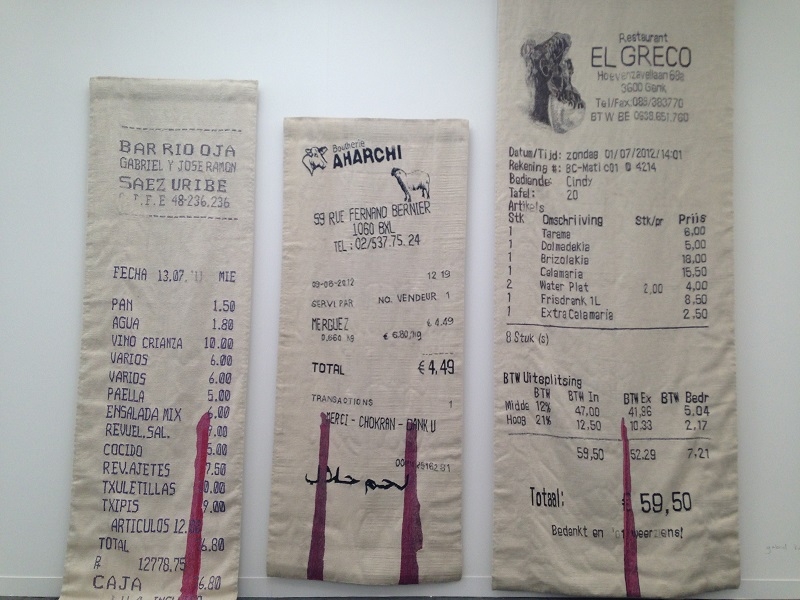
The first thing the reader will need to know will be a bit of history on branding, since as society changes, branding and packaging have replaced the need for a relationship with the shopkeeper, meaning the brand needs to be strong enough for the product to sell itself (Humphery, 1998, p.65 & 87). My audience will then want to know more about how people often fall into the trap of believing advertising as reality (Cummings, and Lewandowska, 2000, p.76), which causes them to purchase new brands, beginning to reveal the falsity of consumerism (Bowlby, 1993, p.3)

My audience will probably then want to know more about the reasoning behind branding, and how it works, as due to the high volume of items on the market, a wide choice needs narrowing down to the appropriate consumer (Humphery, 1998, p.93). I will then discuss whether once this initial brand impact has been made it can be difficult to change brand loyalty (Cialdini, 1993, p.73), or if brand loyalty is more of a myth (Humphery, 1998, p.126). Here I will also look at the connotations of fig. 1.

If possible I will undertake my own research here in order to find out if viewing the products packaging alters the consumers’ willingness to buy the product, possibly through blind tastings.

The reader will then want to learn more about the place of consumers within the shopping industry, so I will explore the idea that consumers do not realise they are no longer in control anymore, as buying has become more of a performance than anything (Cummings and Lewandowska, 2000, p.22 & 131). In order to explore this further I will discuss how consumers may buy in order to fill the desire to have the newest and best (Humphery, 1998, p.193), but not necessarily what is needed or desired (Bowlby, 1993, p.8 & 14-15).

Finally, I will discuss the impact all of this has on the individual, and how this consumerism is not just the big companies’ faults, as consumers fuel it (Humphery, 1998, p.196), and in a way direct it, for example as the public begin to become more concerned with ethics in consumerism (Harrison, Newholm and Shaw, 2005, p.202), the shop must reciprocate in order to keep loyal customers (Bowlby, 1993, p.95). I will also look at the possibility of shops using this concern for ethicality to promote their brands through false intentions, and what impact this has on the everyday consumer (Harrison, Newholm and Shaw, 2005, p.223 & 228).

Image Analysis

Key words:

Purpose- Why has it been made? And why is this important?
Audience- Who is it for? What decisions have been made for these people?
Context- Where does it appear? What format is it in? And when was it created?
Message- What is it trying to say? Why is this important?
Content- What is visually in the image? How does this support the message? -Composition

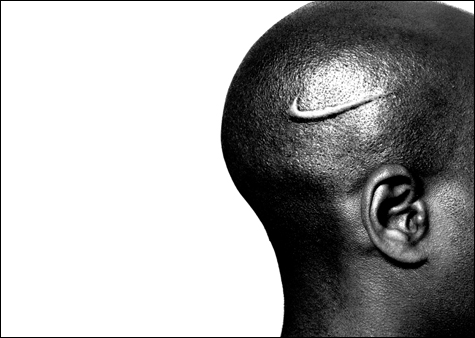
This image was created by artist photographer Hank Willis Thomas, with the purpose to persuade and shock the audience, by revealing how individuals are constantly trying to create their own brand by what they wear and buy, but the consequence of this is that people often just label themselves through wearing other peoples brands. In addition, the connotations of this image could be much more sincere, as they echo the branding of an animal, which leads the audience to believe that consumers are nothing more than sheep following the crowd in their 'unique' brands. The audience of this image will most likely be brand loving consumers, as the image is trying to persuade them to think deeper about what their possessions really mean about them, as well as exploring the unrealistic lengths people will go to to make themselves individual, ironically through the permanent fixation of a global brand onto themselves. Furthermore, the composition of the image itself shows a mocking tone, as it could almost be an advert through the dynamic and bold composition which is very athletic looking, which may be to echo how people will buy anything if it has the right look. Overall this image has a very sophisticated and multi layered tone which really reveals how much of an impact consumer brands have on the individual.

Thursday, 12 November 2015

Lecture- Print Culture & Distribution

Print had a massive impact on distribution of image, as in 1820 it was realised that printing could make more money, as copies of paintings could be sold many times over at a very small cost, which began to feed the mass image culture, since everyday people could now own their own artwork.

The paintings chosen for replication were often because their visual quality was easy to reproduce, not necessarily because of their visual quality, such as the examples below.

'Culture is the best that has been thought and said in the world'- Matthew Arnold author of culture and anarchy
-seeks to minister the diseased spirit of our time.

Leavisism- Traditional beaux arts over 'popular' arts, very much dictated by class

In addition this panning out of arts to a wider audience introduced a pop culture in arts, which was not cognitive but is addictive and is used as an escape from the everyday, a pre-curser of modern day pop culture.

'The work of art in the age of mechanical reproduction' -Walter Benjamin 1936


Friday, 6 November 2015

Lecture- What is Research

Experimental learning= Learning through doing

Process is more important than outcome

Types of research:
Primary research- For specific end use, collection of data that didn't exist before
Secondary research- Already collected data e.g. books-using other peoples work in yours
Quantitative- Numerical data-measured
Qualitative- Words- to the degree

'Information is the result of processing, manipulating and organising data in a way that adds to the knowledge of the person receiving it.'

Assimilation
-The accumulation and ordering of general
information and information specifically related to the problem in hand

General study:
-The investigation of the nature of the problem
-The investigation of possible solutions or means of solution

Development:
The development and refinement of one or more of the tentative solutions isolated during general study

Communication:
The communication of one or more solutions to people either inside or outside the design team


Thursday, 29 October 2015

Lecture- History of Type

Type is what language looks like, it is the translation and visualisation of language, which includes tone and accent.

All that is necessary for language to exist is an agreement amongst a group of people that one thing will stand for another.

Cuneiform System:  Pictograms lost early forms and became conventional signs

1450- Johannes Gutenberg-producing/designing type through wood press
1870- William Foster brought in the education act
1919- Walter Gropius established the difference between the form and function of type
1919-33- Bauhaus brought creatives together with industrials for mass production- mass produced type to create mass produced type matter
1957- Max Miedinger created the Helvetica typeface
1982- Microsoft created the Ariel typeface, 25 years after Helvetica, enough time for intellectual property to lapse
1990- Steve Jobs creates the macintosh, the first computer to have a mouse and be affordable

There is no single approach within typography that applies to everything


Cop workshop

Through looking at our chosen collected images, we produced a set of drawings related to different aspects, such as things which demonstrate the image, places which show the image or careers which are related to them. 

We then created visual responses to our own drawings in order to establish a piece which encompasses the main points from the collection of images. I thought this process was really valuable as it is an interesting introduction into how to translate information quickly into a visual collection of images, which is a huge part of the Context of Practice module.


Wednesday, 21 October 2015

What is the relationship between branding and The Consumer Self?


Sources:
https://s-media-cache-ak0.pinimg.com/736x/28/20/95/28209580a6f31c2beb26cd47374e2bce.jpg
http://blogs.icemd.com/blog-neuromarketing-when-the-brain-sells/wp-content/uploads/sites/732/choices_268x268.jpg
https://s-media-cache-ak0.pinimg.com/736x/ac/0b/f2/ac0bf20edc93f74d1388838f20b51564.jpg
https://s-media-cache-ak0.pinimg.com/736x/10/cc/17/10cc17f115a6fb81d62cd83221912e6d.jpg
https://s-media-cache-ak0.pinimg.com/736x/bc/88/e2/bc88e252ba2e867792e4dab92da95917.jpg
https://s-media-cache-ak0.pinimg.com/474x/60/0f/ec/600fecead1982c3f68b2db6ae3a84f49.jpg
https://themediaameetingpoint.files.wordpress.com/2012/04/adb320e6bcd8f88770ef6a29f78ac528
https://s-media-cache-ak0.pinimg.com/474x/3c/e0/a2/3ce0a21b15b1bf54de0f5ad4b6c6552c.jpg
https://s-media-cache-ak0.pinimg.com/736x/72/63/9c/72639cdcb8d8d505f3c7c7db5b9093ce.jpg
https://s-media-cache-ak0.pinimg.com/736x/ed/6e/b4/ed6eb4ff7bfab85c777d745002adf023.jpg
https://s-media-cache-ak0.pinimg.com/474x/28/0e/4d/280e4da5db8002063fbc4d0dc2279efd.jpg
https://s-media-cache-ak0.pinimg.com/474x/50/c1/e9/50c1e9751e6241e340957d04d5cb6b26.jpg
http://en.geourdu.com/wp-content/uploads/2012/11/Chris-Jordan-Main-02.jpg
http://www.incaproductions.co.uk/wp-content/uploads/2014/03/Chanel-686x437.jpg
http://images.elephantjournal.com/wp-content/uploads/2014/11/target-ad.jpg
https://cgutie8.files.wordpress.com/2014/02/world-of-consumerism.jpg
http://thephoenix.com/secure/uploadedImages/The_Phoenix/Arts/Museum_And_Gallery_Reviews/BRANDED_willisinside.jpg
http://www.adbot.in/wp-content/uploads/2015/05/Coke-and-Pepsi.jpg
http://mongoosmagazine.com/wp-content/gallery/frieze-2/gabriel-kuri-receipts-2013-kurimanzutto-gallery-1.jpg
http://farm4.static.flickr.com/3697/13166813923_84530939e7_m.jpg


Monday, 19 October 2015

Study task 2 Reading and understanding a text


Tone of voice
Authoritative but unbiased

5 key points

- Power is balanced between different social aspects, which all have their own automatous values, yet the outcome varies depending on situation and specific situations
- Ideologies impact on every aspect of peoples lives, the only way this isn’t the case is if things are viewed through a scientific discourse
- Messages are constructed by relying on peoples shared knowledge, meaning that value can be found through the connotations of what is not in the text just as much as what is in it
- Deliberate spaces within advertising should not be criticised, as the choice to exclude them is just as important as the choice to include them
- Consumerism is a never ending circle of products creating an attraction, which ensures consumers want to purchase them initially, trapping them into a cycle of buying and consuming and buying and consuming

5 key quotes
- Social formation consists of three practices: the economic, the political and the ideological
- The relationship is both real and imaginary in the sense that ideology is the way we live our relationship to the real conditions of existence at the level of representations
- To read a text symptomatically therefore, is to perform a double reading: reading first the manifesto text, and then, through the lapses, distortions, silences and absences.
- competent critical practice is not to make a whisper audible, nor to complete what the text leaves unsaid, but to… explain the ideological necessity of its... structuring incompleteness
- Like all ideology, advertising functions by interpellation

Evaluation
Throughout the text, Storey talks broadly of Althusserianism and the impacts this has on audiences, especially with regard to how consumers respond to advertising. When considering historical views and traditions, as well as the politics of modern social interaction, he explains that ‘Social formation consists of three practices: the economic, the political and the ideological’. Storey expands on this to show how power is balanced between different social aspects, which all have their own automatous values, yet the outcome varies depending on situation and specific situations. The cultural impacts of this are the way ideologies impact on every aspect of peoples lives, with the only way of this not being the case is if things are viewed through a scientific discourse. He explains this through the theory that, within advertising, ‘the relationship is both real and imaginary in the sense that ideology is the way we live our relationship to the real conditions of existence at the level of representations’. Furthermore, through considering the cultural considerations of a text, a double reading must be performed ‘reading first the manifesto text, and then, through the lapses, distortions, silences and absences’, as messages are constructed by relying on peoples shared knowledge, meaning that value can be found through the connotations of what is not in the text just as much as what is in it. Because of this, deliberate spaces within advertising should not be criticised, as the choice to exclude them is just as important as the choice to include them, as ‘competent critical practice is not to make a whisper audible, nor to complete what the text leaves unsaid, but to… explain the ideological necessity of its... structuring incompleteness’.  Due to this increase in knowledge of what makes a good advertising text, consumerism is growing rapidly, as the technology becomes available to make more and more, the functions of ‘interpellation’ ensure that consumerism is a never ending circle of products creating an attraction, which ensures consumers want to purchase them, trapping them into a cycle of buying and consuming and buying and consuming [Storey, 2008:70-79]

Storey, J. (2008) Cultural Theory and Popular Culture', 5th ed, London: Pearson. pp. 70-79.